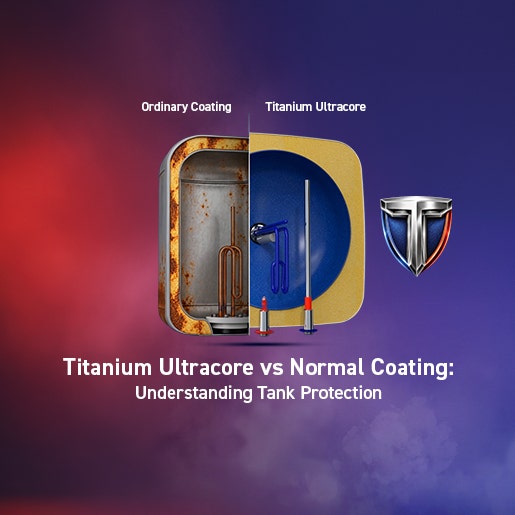
Titanium Ultracore vs Normal Coating: Understanding Tank Protection
Published on
2026-11-05T00:00:00.000Z
true

_blank

_blank

_blank
bg-primary
<p>When choosing a geyser, it is easy to focus on capacity and heating performance. But the protection inside the tank matters too. Every heating and cooling cycle causes the tank and its coating to expand and contract. Over time, repeated thermal stresses can challenge the coating’s integrity. Hard water presents a separate concern: mineral scale. In this article, we compare an ordinary tank coating with Racold’s Titanium Ultracore, and explain what to check when choosing a geyser for hard water.</p><h2>What Is Hard Water and Why Does It Matter for Geysers?</h2><p>Hard water contains dissolved minerals, mainly calcium and magnesium. When water is heated, mineral deposits can accumulate on the heating element and internal surfaces. This is scaling. It is important to distinguish it from thermal fatigue:</p><ul><li><strong>Scaling:</strong> Mineral deposits can interfere with heat transfer and create a need for servicing.</li><li><strong>Thermal fatigue:</strong> Damage can accumulate from repeated temperature-driven expansion and contraction. This can occur in both hard- and soft-water conditions.</li></ul><p>Scale management and tank protection serve different purposes. In hard-water areas, a durable internal coating becomes particularly important for long-term tank protection.</p><h2>Why Tank Coating Is Your Geyser’s First Line of Defence</h2><p>In a <a href="https://www.racold.com/electric-storage-geyser">storage geyser</a> with a coated steel tank, the internal coating acts as a protective barrier between the water and the steel. Maintaining that barrier helps resist corrosion. This coating’s ability to cope with repeated heating and cooling is therefore an important part of tank protection.</p><p>As temperatures rise and fall, the tank and coating expand and contract. Differences in how these materials respond can create thermal stress within the coating and at its interface with the steel. Thermal stress is the loading; thermal fatigue is damage that may accumulate over repeated cycles. If the protective coating is compromised, water can reach the steel surface of the tank and corrosion may develop, depending on water quality and the hardness of the water.</p><h2>How Thermal Cycling Can Affect a Tank Coating</h2><p>Thermal cycling can contribute to coating deterioration through the following chain of events. This is a possible mechanism, not an inevitable outcome for every tank:</p><ol><li>Repeated heating and cooling create cycles of expansion and contraction, which can generate thermal stress on the tank as well as on the protective coating.</li><li>Over many cycles, thermal fatigue may contribute to cracks, chipping or loss of coating adhesion.</li><li>Iron in the tank reacts with water and oxygen, and rust begins.</li><li>Over time, this leads to leaks and loss of performance.</li></ol><p>Hard water speeds this up because mineral deposits add stress to the inner surface.</p><h2>What Is Titanium Ultracore?</h2><p>Titanium Ultracore is Racold’s advanced inner-tank protection technology, engineered to withstand years of thermal stress.</p><p>Its titanium-infused tank coating provides superior protection against corrosion and thermal stress, delivering long-lasting durability and reliable performance, even in hard water conditions.</p><p>Racold highlights three benefits:</p><ul><li><strong>Unmatched resistance to thermal fatigue:</strong> Built to cope with the repeated expansion and contraction of heating cycles.</li><li><strong>Unmatched performance in hard water:</strong> Designed for areas where mineral-rich water is the norm.</li><li><strong>Unmatched coating protection:</strong> Keeps moisture away from the tank’s metal.</li></ul><p>According to Racold, it is available on select models, so check with your dealer for the exact list.</p><h2>Titanium Ultracore vs Normal Coating: Side-by-Side</h2><table border="1" cellpadding="8" cellspacing="0"><thead><tr><th>Factor</th><th>Normal coating</th><th>Titanium Ultracore</th></tr></thead><tbody><tr><td>Thermal stress</td><td>Can weaken over repeated heating cycles</td><td>Designed to withstand years of thermal stress</td></tr><tr><td>Hard water</td><td>Coating integrity can become increasingly important</td><td>Designed for strong performance in hard water</td></tr><tr><td>Tank protection</td><td>Provides a protective barrier between water and the steel tank</td><td>Titanium-infused coating designed for enhanced tank protection</td></tr><tr><td>Long-term durability</td><td>Performance depends on coating integrity over time</td><td>Designed for long-lasting durability and protection</td></tr></tbody></table><p>An ordinary coating provides a protective barrier between water and the steel tank. However, repeated heating and cooling can create thermal stress that may weaken the coating over time, leading to cracks or micropores. If water reaches the steel surface through these weak points, corrosion can develop and eventually affect the tank’s durability.</p><p>Titanium Ultracore is designed to withstand years of thermal stress, which helps it perform well even in hard water conditions. The last row reflects Racold’s design claims, not a guarantee, so check the warranty terms for the model you choose.</p><h2>Which Is Better for Hard Water?</h2><p><strong>Titanium Ultracore is the better choice if you live in a hard water area.</strong> Its titanium-infused coating is engineered to withstand years of thermal stress from repeated heating and cooling cycles, while delivering reliable performance in hard-water conditions. An ordinary coating has more risk of failure in such a scenario.</p><p>Over time, maintaining the integrity of the tank’s protective coating is important because it helps prevent water from reaching the steel surface, thereby helping protect against corrosion. If you notice white deposits or scale on taps and fixtures, your water may contain higher levels of minerals, making tank protection an important consideration when choosing a water heater. Titanium Ultracore is available on select Racold models, so check the product features before making your choice.</p><h2>FAQs</h2><h3>1. Is Titanium Ultracore better than a normal coating for hard water?</h3><p>Yes. Titanium Ultracore is designed to provide enhanced tank protection and reliable performance in hard-water conditions. Its titanium-infused coating is engineered to withstand years of thermal stress caused by repeated heating and cooling cycles, supporting long-term tank durability.</p><h3>2. What is thermal fatigue in a water heater?</h3><p>Thermal fatigue is the gradual effect of repeated heating and cooling cycles. As the tank and its coating expand and contract, repeated thermal stress can affect the coating over time. Titanium Ultracore is designed to withstand years of such thermal stress.</p><h3>3. Does hard water damage a geyser?</h3><p>Yes. Hard water contains minerals such as calcium and magnesium that can form scale when heated. Scale can affect heat transfer and increase the need for servicing. Regular servicing and effective tank protection are therefore important in hard-water conditions.</p><h3>4. Do all Racold geysers have Titanium Ultracore?</h3><p>No. Racold says it is available on select models only. Ask your nearest dealer or check the model’s feature list before you buy. This is the quickest way to be sure the geyser you choose has it.</p>
bg-primary
Related Blogs
align-center
btn-primary
_self
btn-secondary
_self
bg-primary
manual
btn-primary
_self

WATER HEATER AND GEYSER
Water Heaters and Energy Efficiency: What the Labels Mean
Read More
btn-terthiary
_self

WATER HEATER AND GEYSER
Solar Water Heater vs Heat Pump: Exploring the difference between both
Read More
btn-terthiary
_self

WATER HEATER EXPERTS
Debunking Water Heating Myths and Common Misconceptions
/content/racold/blog/water-heater-and-geyser/debunking-water-heating-myths-and-common-misconceptions
Read More
btn-terthiary
_self